
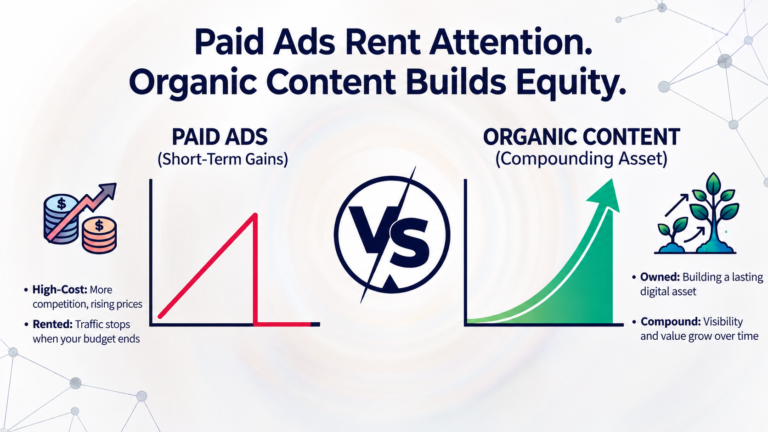
Not every business can afford paid advertising – and, as the costs for paid ads increase year-on-year, many are looking for alternative options. Small businesses on low budgets are focusing on low-cost organic content marketing out of necessity. But what they’re discovering is, when it comes to paid ads vs organic content marketing, the organic option is delivering more benefits – for less outlay.
While paid advertising, such as Google Adwords, can deliver results in the short-term, the moment you stop paying, the benefits end. Meanwhile an organic content marketing strategy delivered by an experienced professional keeps on delivering long after paid ads have ceased working, leaving behind ever-green assets that businesses can use as a long-term growth engine.
That is precisely the philosophy behind The Content Marketer.
Organic content can deliver 3X as many leads as traditional outbound marketing with 62% of the budget.
Organic content delivers more leads – While paid ads can produce quick results, over the long-term, organic content can deliver as much as three times more leads. Someone looking for a solution to their problem is far more likely to read a blog, or a guide, than click an ad. In fact, many searchers feel paid ads are overly-salesy, or even deceptive. They want solutions to their problems from a trusted, expert source. While paid ads stop when you stop paying, organic content educates and positions you as the expert in your niche – and keep on delivering.
CPC (Cost Per Click) for paid ads is up 15% YoY, while CAC (Customer Acquisition Costs) has surged 222% over eight years.
Paid ads are becoming unaffordable for many businesses – As demand for keywords and phrases increases, so does CPC (cost per click). This might not be a problem for big companies with unlimited budgets, but when smaller ventures want to renew a paid ads campaign, they will often see an increased bid price and will need to spend even more to achieve a prime position. What happens then is the company with the bigger budget pays more, and prices increase again.
Moreover, platforms have not grown ad inventory, leading to increased competition for the same ad inventory. 50% of specialists believe managing a PPC campaign is getting more difficult than it was in the past, thanks to platform algorithm changes, cost volatility and increased competition from AI-generated content.
Organic Search produces better leads: Organic leads convert at 14.6% vs 1.7% for outbound, closing 8x more often with higher loyalty.
Organic search creates more quality leads – Because users find organic content by intent, it creates more trusting, quality leads. Customers see them as more credible than sponsored ads, which are often perceived as intrusive. Organic content nurtures more engaging, long-term relationships with audiences.
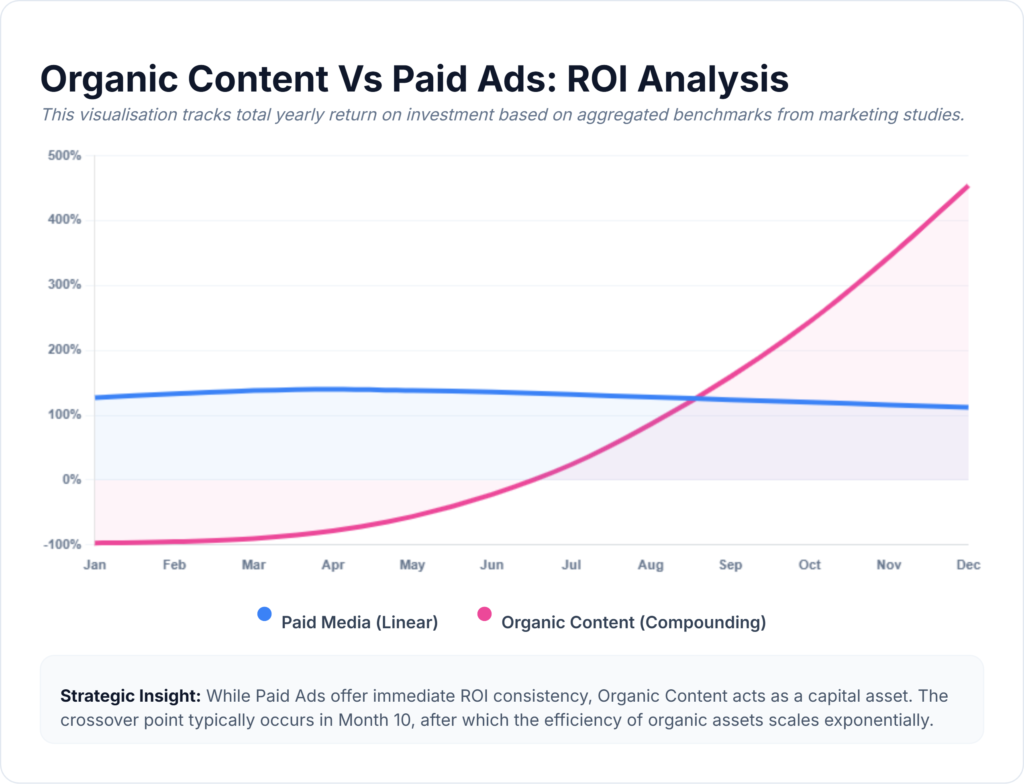
SEO-driven organic content delivers 748% ROI for high-intent keywords. PPC averages 200%.
Organic content delivers higher ROI – While PPC will deliver immediate results, organic content is an asset that compounds over time, driving ROI and reducing CAC. While some marketers will aim for immediate results in order to demonstrate effectiveness (and impress their bosses/clients), it doesn’t compare like with like. ROI is still the key metric it’s always been, and, in the battle between paid ads and organic content, the data shows, over time, SEO-integrated organic content wins. The reason for this is PPC ROI is linear – the return remains flat. The ROI for organic SEO content is cumulative. A piece of organic content can drive qualified leads without any additional spend months or even years down the line.
Spend less, gain more.
When considering the differences between paid ads vs organic content, remember that paid ads are a cost centre; organic content delivered by an expert is an asset. Evergreen content has a compounding effect, offering advice and expertise that will keep attracting new customers. The key here is to mix evergreen content with more topical content to keep existing viewers coming back.
While paid ads can work for short campaigns, organic content wins hands-down for low-cost, long-term growth, building trust and acquiring customers. With paid ads, you rent attention. With organic content, you own it.
Organic content isn’t free, of course, but when comparing paid ads vs organic content, it costs less and delivers more ROI. That’s ideal for small ventures, offering lower long-term CAC, while building brand authority and trust: sustainable traffic without constant spend.
When choosing between paid ads vs organic, you mightn’t be able to outspend your competitors, but you can out-content them with the The Content Marketer.